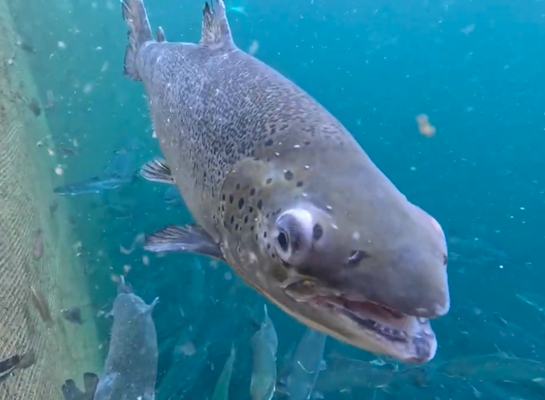
Scotland's salmon farmers have been caught altering the DNA of an endangered species.
Not by campaigners. By their own government, using their own regulators' money, in their own rivers.
Salmon Scotland's response is to attack campaigners.
Not one word of regret. No acknowledgement that the finding is even real. Just a line about forty other pressures on wild salmon, a recital of job numbers, and a complaint that critics only ever want to blame somebody.
Dale Vince, our founder, said:
"Wild salmon have been in existence over 70 million years, but in just a few decades the salmon farming industry in Scotland, entirely foreign owned by the way, has corrupted its DNA. Millions of years in the making, decades in the breaking, in pursuit of a buck, or indeed a krone, the currency of Norway where most of Scotland's farms are owned."
What they found
Scottish Government scientists tested 6,639 wild salmon at 834 river sites across the country. They found farmed salmon DNA in wild fish across a fifth of Scotland's salmon rivers.
In farming areas, wild salmon carry nearly six times as much farmed ancestry as fish elsewhere. In Lochaber, the heart of the industry, contaminated fish turned up across 72 per cent of the river network. Twenty five of the twenty eight regions surveyed are affected.
And the true picture is worse than that. The scientists say so themselves.
So why has nobody heard about it?
Four public bodies paid for this work. The Scottish Government, SEPA, NatureScot and Crown Estate Scotland, which leases these companies the seabed they farm on.
Not one of them announced it.
No press release. No statement. No ministerial comment. The paper went out on 5 August and sat there untouched.
It is worth knowing how the same scientists' earlier introgression work was handled. In 2021 and 2022 it was published on the government's own website, where the public could find it. This one appeared in an academic journal and nowhere else.
You commissioned it. You paid for it. It found something serious about an endangered species. Why did none of you say a word?
The only people who cannot see it
Fisheries managers can see it. Anglers hauling farmed fish out of the Lochy by hand can see it. The government's own scientists can see it, and now they have measured it.
The industry cannot.
One sentence was all that was needed. These are our fish, we are sorry, and we will stop it happening again.
They can't or won't do it.
"Zero escapes"
That is what Salmon Scotland claim its members work incredibly hard to achieve but the factory farmed fish genes in these rivers are the receipt.
And this is the part that should stop people cold. You can treat sea lice. A fouled seabed recovers if you fallow it. This does not. Nobody can go into a river and take it back out. It passes down through every generation, for as long as those salmon exist.
The jobs they hide behind
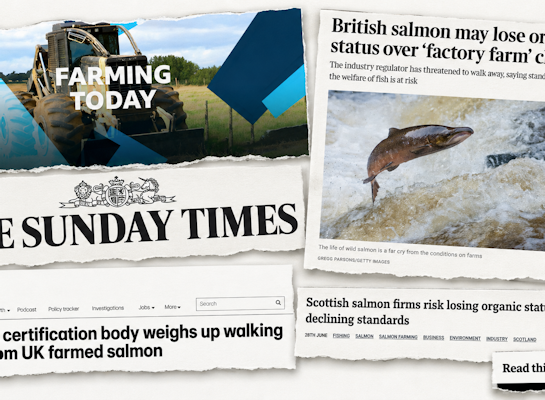
They told The Times the sector supports 11,000 jobs. Most of those are indirect. Their own careers page claims 2,500 direct.
The Scottish Government's production survey tells a different story again. Staff directly employed in Atlantic salmon production fell to 1,362 in 2024, from around 1,480 the year before. Shetland dropped from 312 to 267.
Production rose 27 per cent over the same period.
More fish. Fewer people. The jobs argument is a paper shield held up by an industry that is shedding the jobs.
They will never say it
An apology would mean admitting harm to Scotland's rivers. It does not accept it's environmental impact and clearly does not intend to start now.
So it will keep telling us about the other pressures on wild salmon, and the eleven thousand jobs, and the extremists at the gate, while the fish in these rivers quietly stop being Scottish.
Wild salmon have been in these waters since the ice went. They are being redesigned by an industry that will not admit it is responsible and by public bodies that found the evidence and said nothing at all.
Gilbey, J. et al (2026), ICES Journal of Marine Science, Vol 83, Issue 8. Open access: https://academic.oup.com/icesjms/article/83/8/fsag153/8751554