

We won. The Soil Association is taking its logo off farmed salmon
Two years of filming, digging and pushing have paid off. Britain's best known organic body has walked away from salmon farming.
Read More
Ben Hadfield, managing director of Mowi Scotland, sat down with The Last Salmon to answer for the world's biggest salmon farmer. He spent the time aggrieved at activists, at the King's "misinformed" advisers, at the weather. And when the death rate was put to him, he didn't deny it. He called it biology. The toll behind that word: more than 3 million animals lost in Mowi's care last year alone, and a royal warrant stripped because of what we filmed.
It takes something to get a salmon-farming boss in front of a microphone. As Jim Murray put it on The Last Salmon, the industry's big wigs are usually so publicity-shy they make vampires look sociable. So credit to Ben Hadfield, managing director of Mowi Scotland, for braving the daylight and credit to Jim and The Last Salmon team for an hour and a half of patient, evidence-led questioning that gave him nowhere to hide.
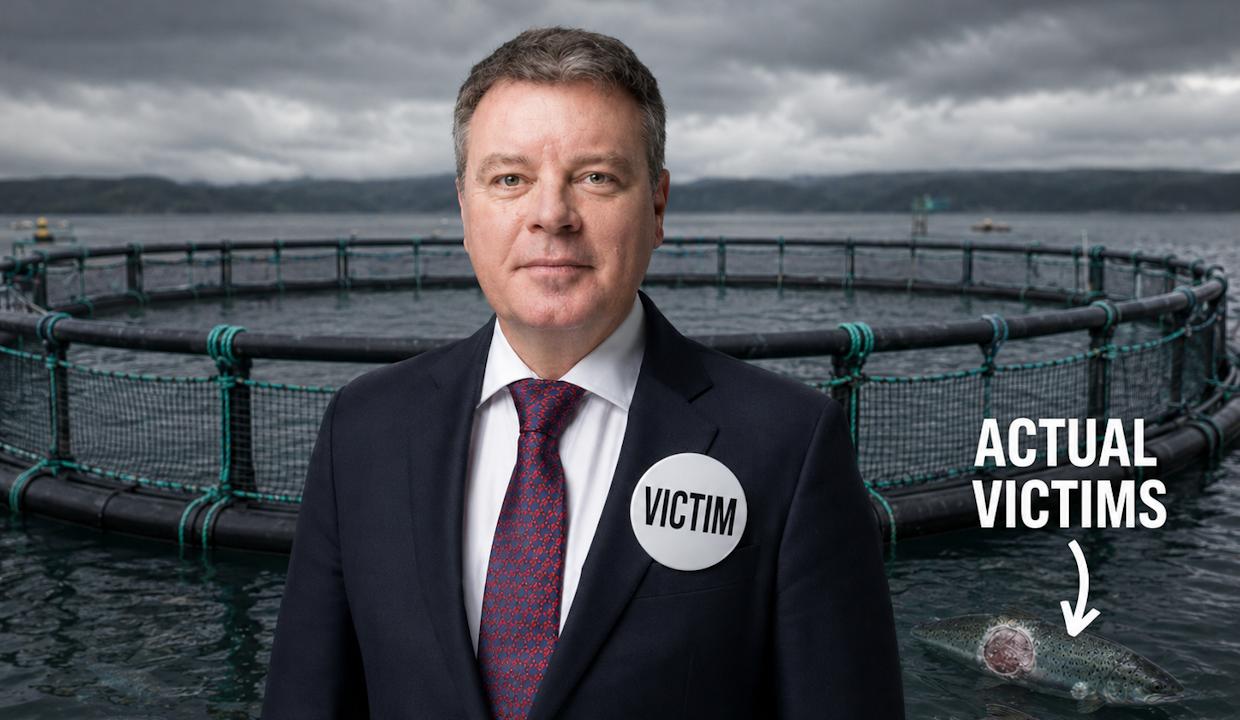
What we heard was a masterclass in playing the victim. Over 90 minutes, Hadfield was wronged by campaigners, let down by overcautious regulators, betrayed by the King's advisers and battered by storms. The one party that never quite made his list of victims was the animals. So let's put them back at the centre using his own words and his own numbers.

The strongest tell came when Jim raised the royal warrant. In November 2025, after 35 years, King Charles stripped Mowi of the warrant it had held since 1989 - the right to stamp the Royal Arms on its salmon boxes worldwide. It came after the Green Britain Foundation released undercover footage from Mowi's Loch Harport site on Skye, showing workers beating fish to death and leaving them to suffocate. That footage drove the Soil Association to issue a critical non-compliance for inhumane killing, prompted the RSPCA to suspend the site, and was reported around the world. A separate escape of 75,000 salmon from Mowi's Loch Linnhe farm compounded the picture.
Hadfield's account of all this? The royal household, he suggested, came under "intense pressure from activists," reacted to it, and got it wrong. When Jim pressed.... so the King caved in and he was wrong? Hadfield ducked: don't put me in a position where I'm saying our king is wrong. But he was happy to say the advisers were misled, that the palace team asked him the same questions "misinformed people" ask, and that he alone seemed to hold the real picture.
When Jim pushed back.... surely the palace had the facts independently of you? Hadfield said no, and let slip that he'd sat with the team making the decision and judged their questions to be the same ones "misinformed people" put to him. Jim's reply went straight to the heart of it: are you the only gatekeeper to this information? Because if even the King can't get at the truth, what hope has anyone trying to decide whether to put farmed salmon on their plate?
The premise collapses on contact. The King is a lifelong conservationist with access to the best scientific advice in the country; he was not lobbied into error by activists. He was informed by evidence we put on the record. As Dale Vince said when the warrant fell:
It's good to see the King, an environmentalist, distancing himself from Mowi. A firm with a history of pollution and animal abuse has no place holding a Royal seal of approval.
A man who spends the interview demanding "transparency" cannot, in the same breath, claim the one institution with full access to his industry was the only party kept in the dark. The King saw what we filmed. He drew the obvious conclusion.
Hadfield didn't dispute the scale of mortalities when it was put to him. Asked whether a mortality rate of 15 to 25%, the share of farmed fish that die before they ever reach harvest, was a fair description, he said he was happy to talk about those figures. He didn't seriously contest the reference to 17 million farmed fish deaths across Scotland in 2024 either. What he did instead was explain it all away.
It wasn't sea lice, he said sea-lice mortality at Mowi is now rare. It was the environment: amoebic gill disease, algae, jellyfish, sea oxygen falling to 60% in places, all of it laid at the door of climate change making the job "tougher to farm." And ultimately it was biology. Salmon, he explained, are strategists that spawn thousands of eggs so that one or two survive, so you "have to just accept" that mortality is higher in farmed fish than in pigs or cattle. He even argued that broiler chickens, once you stretch their six-week cycle across salmon's eighteen months, die at a higher rate. Nothing like a dig at another factory farming industry to try and divert attention.
Set aside the sleight of hand in that chicken comparison. The deeper problem is the worldview underneath it: a 15–25% death rate treated not as a failure to be fixed but as a law of nature to be managed. Jim's point stands.... if cattle or poultry died at those rates there would be hell to pay; you'd have to go back to the Middle Ages to find them. In farmed salmon, it's simply "the biology."
Here is the scale that tidy percentage hides. Mowi's Scottish operations lost more than 3 million animals last year alone, and by our analysis around 21 million over the past five years and that is a floor, not a ceiling, because culls and routine on-farm deaths are not fully disclosed. Hadfield wasn't pressed on Mowi's own multi-year toll and he didn't volunteer it. But it is the real weight behind the number he was so content to "accept" - animals confined by Mowi, fed by Mowi, and dying in numbers that in any land-based livestock sector would cause a national scandal.
The most revealing thing about the interview is how much Hadfield concedes. On escapes and genetic damage to wild salmon, he offered his own analogy: a farmed fish against a wild one is a Labrador against a timberwolf and yes, he agreed, hybridising the two is "a hazard for wild fish." On sea lice, he accepted a hazard exists. So the argument was never really about whether Mowi harms wild salmon. Everyone knows they do. It was about how much, and how fast anyone should be made to act.
Take the Loch Linnhe escape he kept returning to: 75,000 fish out of a pen of 82,000 gone through a torn net, and by his own admission double Mowi's typical annual escape figure. He called it his worst day in the office and mentioned the tree that fell on his house that morning. The worst day, of course, belonged to the fish.
He says Scotland's rules are tougher than Norway's. The results say the opposite. Norway enforces a hard 0.2 lice limit through the smolt migration, with real consequences for breaching it, and farms comply more than nine times in ten. Scotland sets no equivalent limit and no real jeopardy so the criteria get missed routinely. It's the same companies, Mowi among them, that hold the line in Norwegian waters and let it slip in Scottish ones: they comply where failing costs them, and don't where it doesn't
When Jim pressed him on money, the self-pity became hard to sustain.
Just over $1bnMowi's profits in a good year, in Hadfield's own words
£600k a yearWhat he conceded Mowi puts into wildfish mitigation - Very small change compared to harm caused
Jim's verdict on the £600k was blunt and correct: an unforgivably low number. A billion in profit, millions from the taxpayer, and a fraction of that returned to the wild fish the company admits putting at risk.
And when offered concrete ways to do better, the answers were no. Closed containment with deadlines and named sites: no. Independent genetic sampling of rivers within 10km of every Mowi farm, with a 1% introgression trigger: no - he'd rather set the bar at 10% (of course he does). For a man who kept saying he wanted to "do more," he said no to nearly everything that would.
None of this would be on the record without Jim and the team at The Last Salmon, who got a famously evasive industry to sit still and be questioned.
Ben Hadfield wants your sympathy. But the victim here was never the man in the chair, or his shareholders, or even his royal warrant. It's the wild Atlantic salmon sliding toward the edge and the millions of animals dying year after year in Mowi's pens, written off as biology by the man paid to keep them alive.
Two years of filming, digging and pushing have paid off. Britain's best known organic body has walked away from salmon farming.
Read MoreA year after our hidden cameras filmed snares being set at a stink pit on the edge of North Wales' only grouse moor, North Wales Police have charged two men. It is believed to be the first case under the Welsh snares ban on land used for game shooting.
Read MoreOur hidden cameras caught bird flu rules being ignored on his Ashcombe Estate. Trading Standards has now set out the law to him.
Read MoreScotland's environment watchdog has finally handed a file on dead salmon buried on North Uist to prosecutors. It took more than two years after we exposed it.
Read More